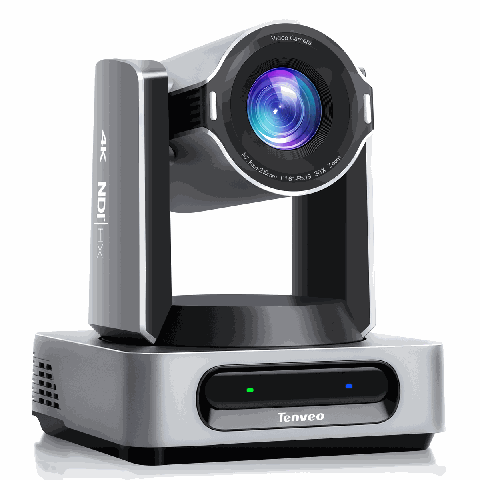
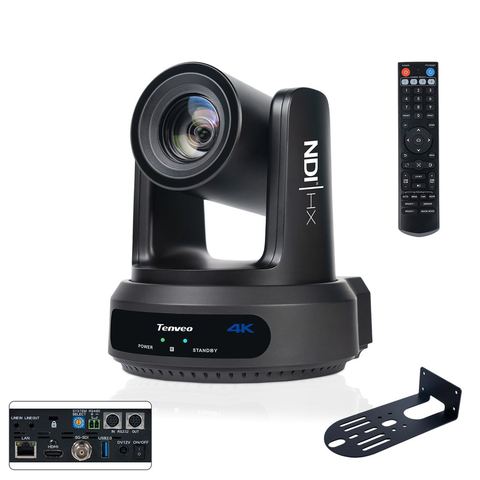
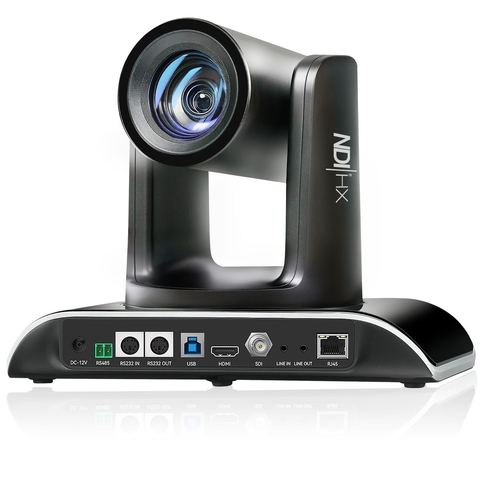
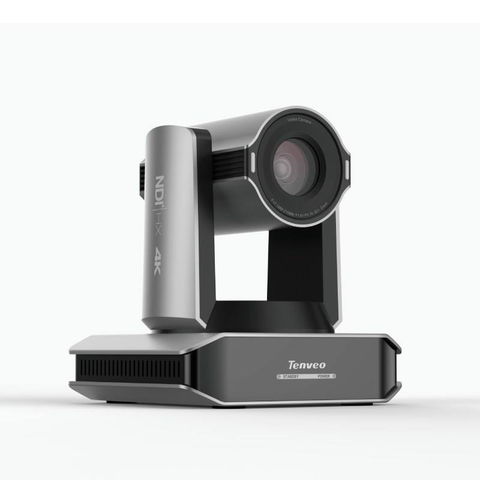
"How much zoom do I need?" is the most common question we get. The zoom number on the box doesn't answer it. What matters is how wide a shot the camera can take at each end of its zoom, and how far it is from the stage. This guide works that out with the field-of-view figures Tenveo publishes.
The two numbers that matter
Every PTZ camera has a widest view (zoomed all the way out) and a narrowest view (zoomed all the way in), both given as an angle. From the angle and the distance, you can work out how wide the picture is at the subject:
shot width = 2 × distance × tan(angle ÷ 2)
Two questions follow for your room:
- Zoomed in: from where the camera is mounted, can it get a tight enough shot of the preacher or presenter?
- Zoomed out: can it fit the whole stage in one shot?
What a good shot looks like
Camera operators describe shots by how much of the person fills the frame. For a 16:9 picture, these are roughly the widths you need at the subject:
| Shot | What you see | Width at the subject |
|---|---|---|
| Close-up | Head and shoulders, for the sermon | about 0.7 m |
| Mid shot | Waist up, with gestures | about 1.4 m |
| Full shot | Whole person, or two people | about 2.8 m |
Zoomed in: how close can you get?
Tenveo lists the narrowest view for several models, and they come out very close to each other: about 3.5° horizontally. That holds for the 30x VX30M-Ultra (3.5°) and VHD630A (3.95° diagonal, about 3.4° horizontal), and for the 20x NV620A-Ultra (4.0° diagonal, about 3.5° horizontal). The 20x model has a larger sensor, so it reaches as far with less zoom. At 3.5°, the shot width at full zoom is:
| Camera to subject | Shot width at full zoom | Tightest shot you can get |
|---|---|---|
| 10 m | 0.61 m | Close-up |
| 15 m | 0.92 m | Close-up |
| 20 m | 1.22 m | Tight mid shot |
| 25 m | 1.53 m | Mid shot |
| 30 m | 1.83 m | Loose mid shot |
So a camera mounted up to about 11 m away can still get a head-and-shoulders close-up, and one up to about 23 m away can get a waist-up mid shot. For most South African churches, school halls and conference rooms, any of these models reaches far enough.
Zoomed out: will the whole stage fit?
This is where cameras differ more, and where mounting a camera too close causes problems. The widest views are about 59–60° horizontally for the X60, VX30M-Ultra and NV620A-Ultra, and about 65° for the VHD630A and the NVMAX630AN. The minimum distance to fit a stage of a given width is:
| Stage width | About 60° cameras | About 65° cameras |
|---|---|---|
| 6 m | 5.2 m | 4.7 m |
| 8 m | 7.0 m | 6.3 m |
| 10 m | 8.7 m | 7.8 m |
| 12 m | 10.5 m | 9.4 m |
| 15 m | 13.1 m | 11.8 m |
If your only camera position is close to a wide stage, choose a model with a wider view, or add a second camera for the wide shot.
How to measure your room
- Choose where the camera can go: a back wall, a balcony front or a column. It needs power or a network cable, and a clear line of sight over standing people.
- Measure from that point to where the preacher usually stands. A laser measure or a free phone app is accurate enough.
- Measure the width of the stage or platform you want in the wide shot.
- Check both tables above, or send us the two measurements and we'll check them against the camera you're considering.
Other things to weigh up
- Resolution: a 4K camera sent out at 1080p still looks sharp when you crop in slightly in your software.
- Lighting: the more a camera zooms in, the less light reaches the sensor. Dim sanctuaries benefit from the larger 1/1.8" sensors in the 4K60 models.
- Height: mount the camera a little above head height, so it looks over the congregation without looking steeply down on the preacher.
Figures are calculated from Tenveo's published field-of-view specifications and rounded. Shot widths are for a 16:9 picture. Treat them as a planning guide and check on site.
Want a second opinion on your setup?
Send us your room measurements and what you stream to, and we'll recommend a kit and quote it in rand.